
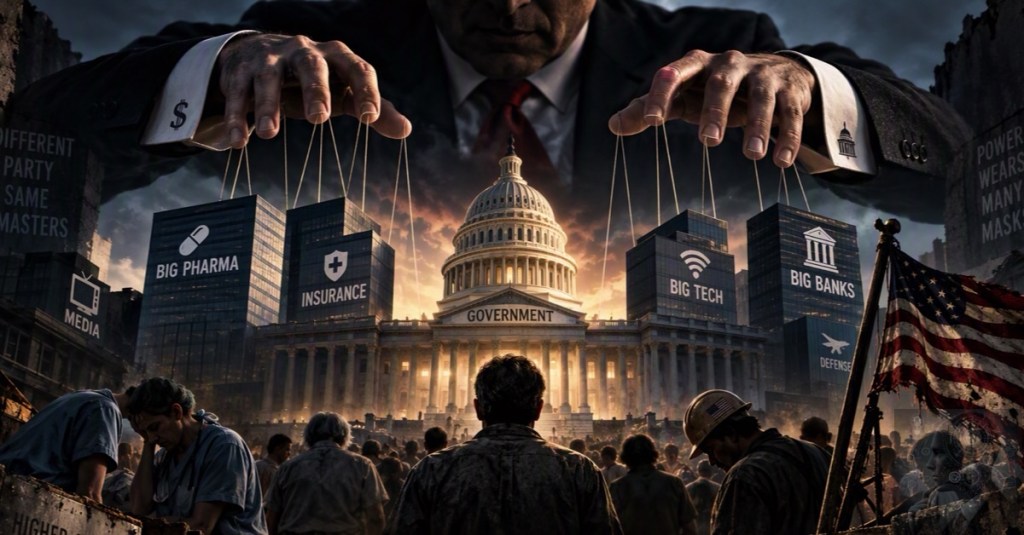
Power – Polluted and Protected
On a Saturday afternoon, a message arrived from a friend in Detroit. He was angry at the rich and powerful again. The complaint was on capitalism and democracy. We have historically voted quite differently, yet we find a lot of common ground.
Especially in today’s populist climate.
I disagreed with his definitions, but I do not dare to dismiss his conclusions.
After years of engaging with one another, I am thankful to call him a friend. He has been an advisor to myself and many others; he’s also considered by our group to be a bit of a blue-collar scholar.
Here is a man who has stared into institutions, machinery, and power structures for decades.
He knows where the bodies tend to pile up.
What he wrote:
“Capitalism and democracy just don’t mix.
Oil and water.
Unchecked capitalism devolves into fascism. I’m sure the other side argues that unchecked liberty leads to socialism.”
There was more; where he also pointed toward healthcare systems that function while ours remains repulsive in both blue and red states alike.
As he is well aware, I am a concerned capitalist shaped by Austrian economics with a deep preference for constitutional republics over mass democracy.
He knows exactly which chords to strike, and I love him for it. And so, I could not resist making my case.
I began writing. As I refined my response, it grew longer. Somewhere in the middle of it, I realized we were both circling the same problem. Cuts were made, but my response was as follows:
“Nothing about what we have here can rightly be called capitalism.
What we have built is a Corporate Republic.
The defender of socialism blames capitalism.
The supposed capitalist blames a failure of democracy.
Neither sees the other side of the beach ball, or the beast standing before us.
Free markets require open competition.
In many areas, that is far from the case. Entire industries are protected by regulatory, legal, and financial barriers.
In most marketplaces, the average citizen cannot realistically hope to challenge dominant institutions, because access itself has become restricted.
Consider what a legitimate lemonade stand requires in permits, insurance, and inspection before operating costs even enter the equation.
Government creates the rules.
Corporations often shape them.
Regulators depend on industry expertise.
Industry depends on regulatory protection.
Shareholders demand growth.
Politicians demand donations.
The result is neither a free market nor democratic accountability.
Economic power is not the same as political power. The danger began when the two became inseparable, almost indistinguishable from one another.
And it is getting worse regardless of which party holds office.
Healthcare further illustrates the problem.
The American system is neither a free market nor a socialized system.
It is Frankenstein’s monster, a labyrinth of insurers, regulators, pharmaceutical firms, hospital networks, lobbyists, shareholders, and government programs.
Every actor claims to represent the patient.
Meanwhile, the middle class is trapped in the mess as debt accumulates.
Hospitals hemorrhage money.
Insurance premiums rise annually while care becomes more procedural and less compassionate.
Each of us knows it.
The question is not whether capitalism leads to fascism or liberty leads to socialism.
It is a matter of terms properly defined.
What happens when institutions become too large to fail, too connected to challenge, and too insulated from the consequences of their decisions?
A market without competition ceases to be a market.
A republic without accountability ceases to be a republic.
Yet Plato might ask these questions: what kind of people permit such institutions to emerge?
If democracy is the father of tyranny, is the cause concentrated power alone, or a citizenry that gradually trades responsibility for comfort, vigilance for convenience, and self-government for management?
Every institution is downstream of human behavior. If we dislike the harvest, we must eventually examine what was planted.
How do we prevent power from becoming so concentrated that neither markets nor republics can survive?”
The conversation felt too important to remain private. Power has a habit of wearing whatever mask the age finds fashionable.
Best to shed light where able!


Leave a Reply