
How a simple chuck complaint turned into a three-day battle with decades of cast iron debris.
For months, I had been complaining about a coworker’s machine. Specifically, the chuck, a lathe work-holding mechanism, and the fact that something about it just wasn’t quite right.
This coworker and his wife recently had a baby, so he is still on family leave. As XIR, I am covering for him.
Fast forward about two days into that coverage, and I stop to ask the third-party specialist to swing by the next time he was around. He stopped in Monday.
Initially, he and I thought it was the actuator, which is connected to a draw tube and, together, drives the clamping of the chuck. After disconnecting it and running the actuator in an isolated state, we discovered it was working fine. The repair kit already on order, an inexpensive first step, was no longer necessary.
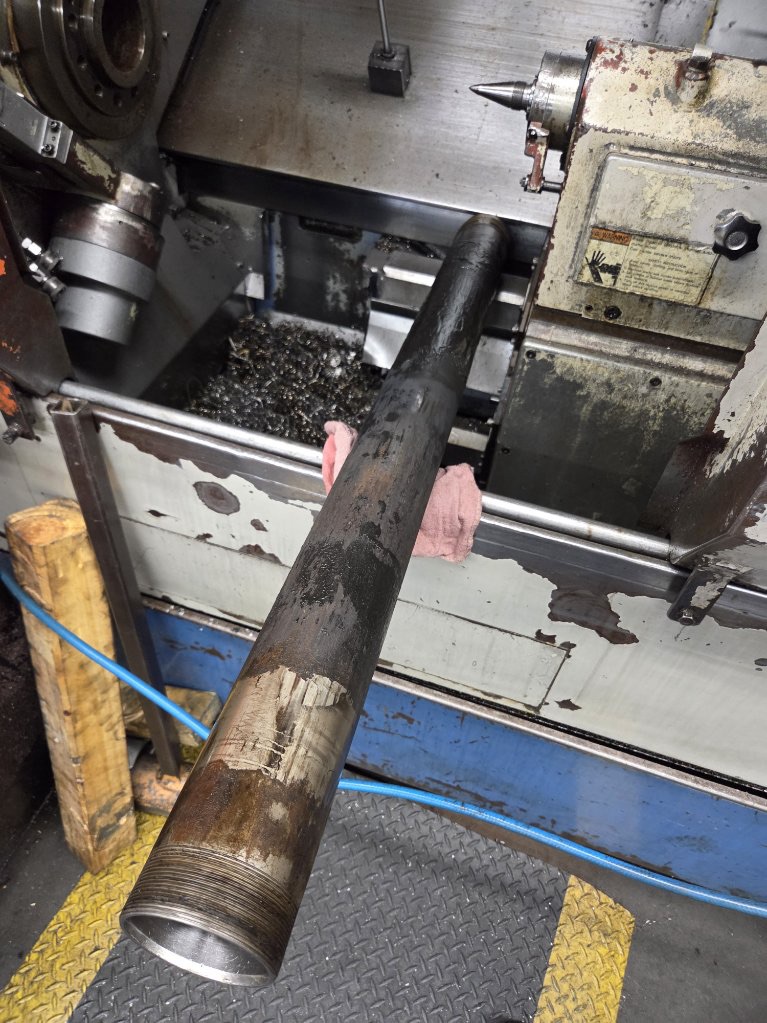
We started trying to force the draw tube out, which should have freely slid in and out now that the chuck had been removed and the actuator was lying on the ground next to the machine.
It wouldn’t budge.
Dead blow hammers wouldn’t free it.
A hydraulic tailstock was tried. It did not budge.
I went home for the evening. The technician was still banging on it.
I walked in the next morning to a 4×4 and our largest sledgehammer leaning against the machine. The draw tube had slightly moved, but not by much. We still had almost the entire four-foot section stuck inside.
Penetrating oil sprayed in came back out like cake batter.
Years, maybe decades, of cast iron debris had solidified into a hardened metallic concrete.
By that point, I had assumed the technical expert had more or less surrendered as I surveyed the mess. I fired up the machine next to it and began cutting chips, all while thinking about solutions. The specialist arrived shortly afterward while I was deep in thought, still running the adjacent machine in the same area.
My assumption was correct. We were up a creek without a paddle.
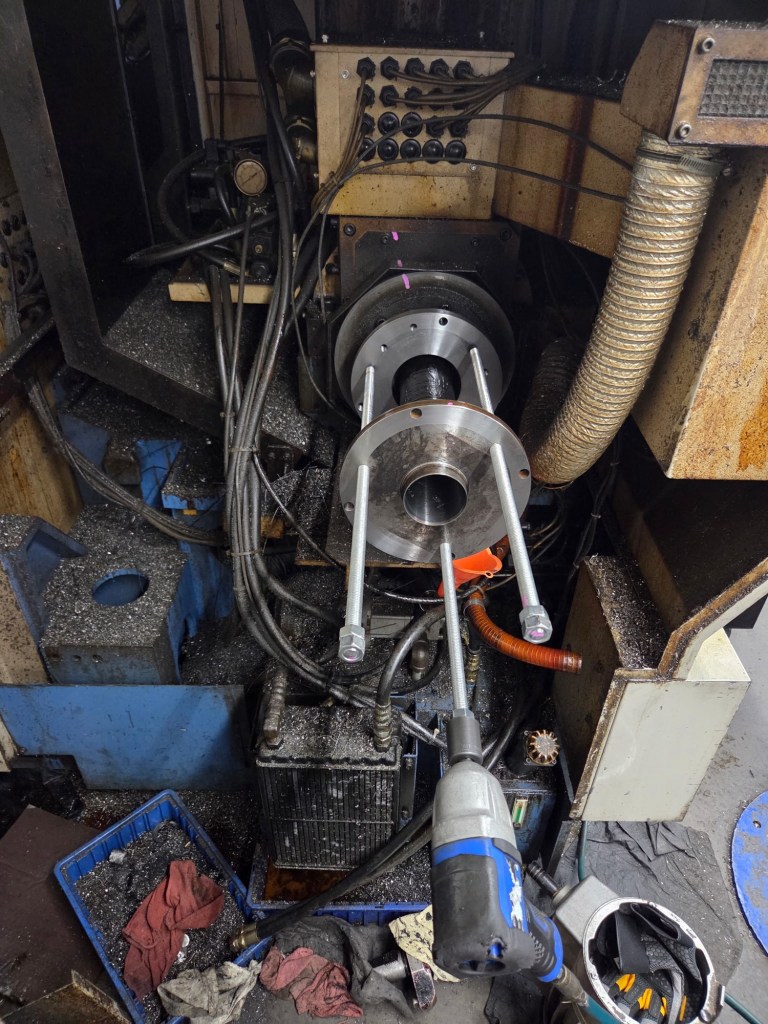
We talked and came up with a jack plate with a tri-bolt drive idea. We discussed the risk of driving threaded rod into the spindle mount and decided we needed a large steel sacrificial plate to protect it.
I ran out back and began digging through old fixture material and various odds and ends.
The attached photos are the successful removal of the draw tube that had been causing the concerns.
What was supposed to be a one-day job turned into three, with the last day consisting of two science-project parts and almost a full day of very loud work.
It sucked, but it was also satisfying solving the problem and saving our ass on an incredible older machine.


Leave a Reply