
There are only ever two choices.
I know that sounds reductive. I love nuance, the infinite threading of complexities through one another, each strand pulling against ten others until the whole thing becomes a woven, living canvas.
Reality resists simplification. And yet.
Strip it far enough and you always arrive at a binary.
This or that.
The long road or the short one.
The way that costs something or the way that doesn’t.
As I heard last month, you’re either choosing Jesus or not.
The Problem With People
I’ve been thinking about this in an unlikely place: a machine shop.
For a while now I’ve been doing the work of continuous improvement in a high-mix CNC environment, which is a technical way of saying I’ve been trying to fix the way things get made, and more importantly, the way knowledge about making things gets held.
The problems I kept finding weren’t really about machines. They were about people. Specifically, what happens when too much lives inside specific individuals and not enough lives inside systems.
The symptoms were everywhere.
Setup times that swung wildly depending on who walked in that morning.
Inspection results that meant one thing to one operator and something different to the next.
Problems that were genuinely solved with intelligence and care, only to reappear months later because the solution lived in someone’s head instead of a document.
Every rediscovery cost full price, as though the answer had never existed.
The capability was real.
The knowledge was real.
It just rarely written down.
The Evaporating Fix
Here is where it gets theological, if you’ll stay with me.
The easy path, when a problem surfaces on the floor, is to fix it.
Walk over, apply what you know, solve the immediate thing, move on.
It’s satisfying.
It feels like contribution.
And it is contribution, but its contribution that evaporates.
You become indispensable in the worst way. Here’s a ‘system’ that only works when you’re present, which means the system isn’t a system at all.
It’s just you, holding something up that cannot stand on its own.
The harder path is to fix the process.
Write down what you know. Train to it.
Create the standard. Build the setup sheet. Make the decision once and make it so clearly that the next person never has to make it again.
This path is slower. Costs more upfront.
It requires stepping back from the immediate problem and asking what kind of problem it is, not just what the answer is.
It asks you to give up the small, addictive satisfaction of being needed for more important but less urgent means to an end.
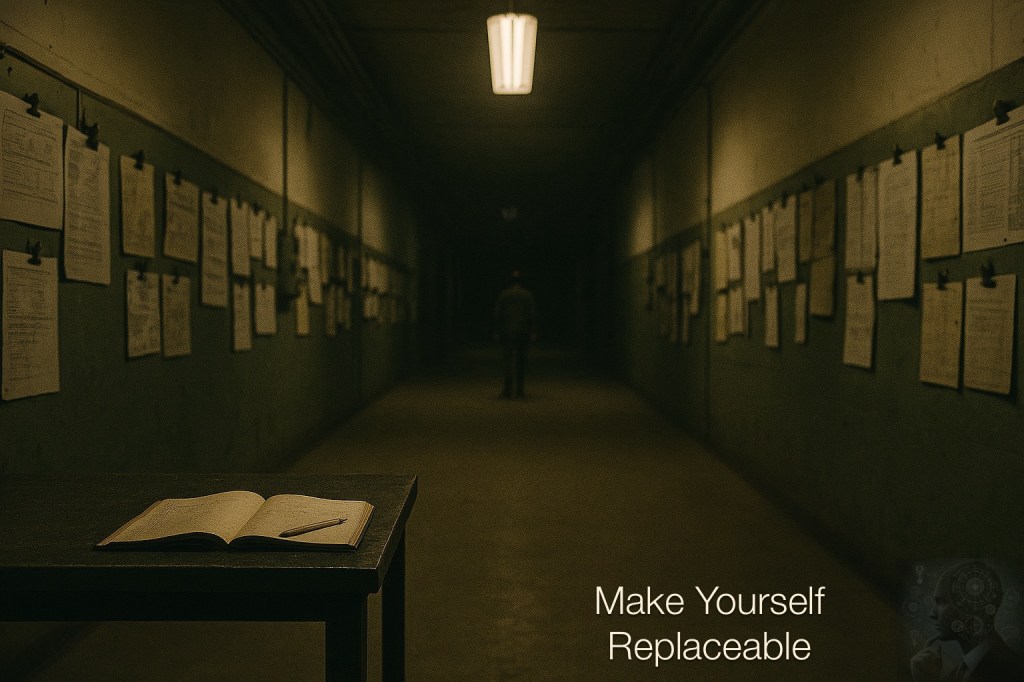
It asks you, in a quiet but real way, to make yourself replaceable. Repeatable.
Every Tradition Knows This
Most traditions that take wisdom seriously have noticed this shape. It is even in my favorite pop culture. Star Wars.
The Jedi and the Sith, if you permit my pop mythology version, aren’t really about power.
They’re about whether you grip or release. The dark side offers the quick path, the immediate result, the feeling of control.
It works, right up until it doesn’t, and by then you’ve become something you never intended to be.
Then the beloved grey, the older ones who hold balance, know both pulls.
They don’t pretend the quick path lacks appeal. They’ve felt it.
They choose the other one anyway, and keep choosing it, because they understand something about what lasts.
What lasts is what cost something today to build a better tomorrow.
The Narrow Road
I think this is another thing Jesus means when he talks about the two roads.
Not simply that one is morally pure and the other corrupt, though that dimension is real, but that one is narrow, which means it requires attention.
You have to navigate.
You have to make decisions that don’t feel good in the moment.
You have to accept that the work of today may not bear fruit until someone else is standing where you stood, and you won’t be there to see it.
The broad road is easy because nothing on it requires you to grow. It’s the road everyone is on, you sense the community despite the chaos.
Nothing on it requires you to build something larger than yourself. You’re a part of the crowd, not wearing life’s crown.
You can walk it your whole life at the same size you started. A clog in the machine.
The narrow road asks for more.
That’s why so fewer people walk it.
Not because it’s hidden, it’s plainly marked. But we avoid it because it costs.
What I’m Building Now
Lately I’ve been tasked with building documentation, desperately needed data.
In the near future I’ll be Formalizing practices that used to work fine as informal habits.
Writing down decisions so they don’t have to be remade again, and whenever they do it will be with a proper understanding.
Creating standards where there used to be personal preference.
It’s slow. Hard to get adopted and It’s often invisible. The machines still run while I’m doing it, which means in the immediate sense it looks like nothing changed.
But here’s what I know going into another new role.
Every standard I don’t write will have to be rediscovered.
Every decision I leave undocumented will cost someone time they don’t have.
Every process I leave dependent on a person, including myself, is a process that will eventually break when that person isn’t there.
The quick fix is real relief. But it doesn’t last.
The system is slower to build and harder to see. But it holds.
What Holds
I don’t think this is only about machine shops.
I think this is the shape of all good work, the kind that outlasts the person who did it, that carries forward into situations the original builder never imagined, that multiplies rather than depletes. It’s the shape of parenting, of teaching, of leadership, of any community that intends to survive its founders.
And yes, it’s the shape of faith, though I’ll leave room for you to follow that thread however you choose.
What I’m less willing to hold lightly is this. There are always two choices. The one that costs and the one that doesn’t. The one that lasts and the one that doesn’t.
Most days, we already know which is which. The hard part isn’t discernment.
The hard part is choosing, and then waking up on the narrow road tomorrow and choosing again, as though yesterday never counted.
We already know this.
That is the whole problem.


Leave a Reply