
Have you ever cherished a book, only to have its memory stained by new understanding?
That’s what happened to me with Outliers by Malcolm Gladwell. I used to love proclaiming the 10,000-Hour Rule. An idea that mastery is simply a matter of time and repetition. With over 50,000 hours in manufacturing you can see why it was so appealing. But time alone doesn’t teach. We all know it, plenty of us know those who are lapped by their junior. I find that in areas where I am weakest, I grow the fastest. I traverse the furthest in these areas. Time alone doesn’t correct us. Repetition by itself doesn’t challenge us. Over months, I gained insights from Dr. Julie Gurner, who is a cognitive alchemist and real-life Wendy Rhodes. I also read Geoff Colvin’s work recently. I’ve come to see the 10,000-Hour Rule as more myth than gospel. It still carries weight. But it demands a sharper definition.
Let me be clear, I still admire Gladwell’s storytelling. Just last week, I was listening to one of his podcasts. Reading Geoff Colvin’s Talent Is Overrated was impactful. It dismantled the notion that repetition over time alone will lead to excellence.
Colvin offers a much sharper lens: one he calls “deliberate practice.” Which is not just doing, but documenting, measuring and doing mindfully. And with feedback which corrects and refines. Deliberate Practice must come with discomfort. With a goal that’s just within reach. Only practice that’s documented and measured is True “Training.”
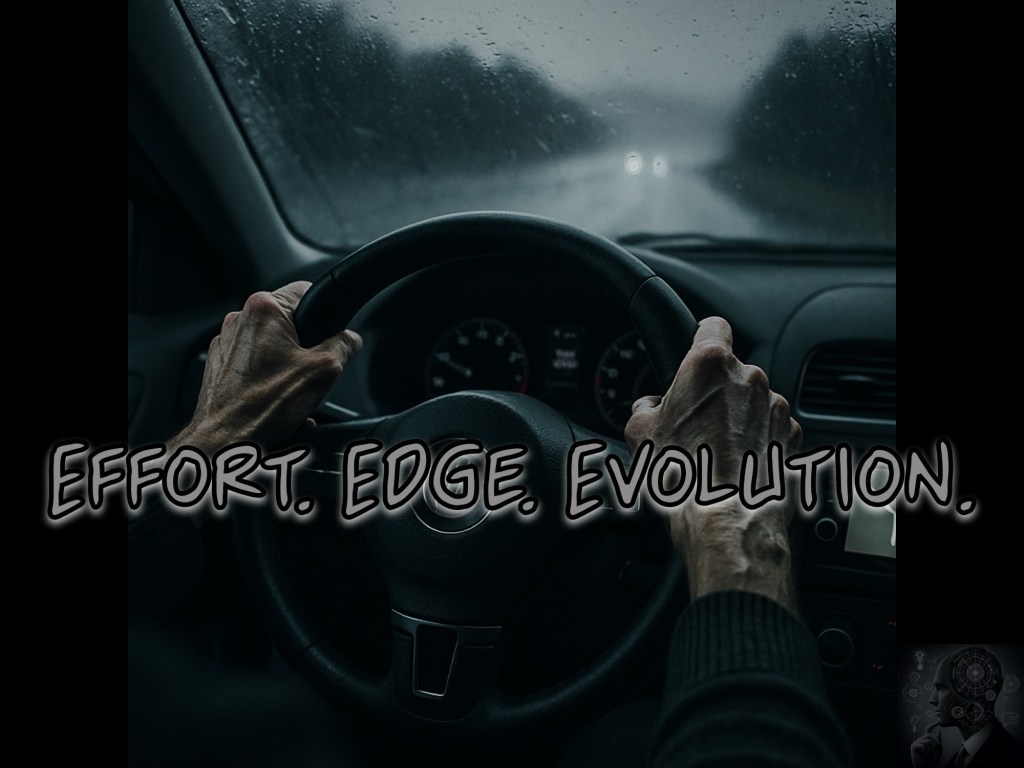
Consider driving. Most of us have spent thousands of hours behind the wheel. Yet so few of us are expert drivers. Especially in extreme conditions or worse unfamiliar vehicles. Why do you think that is?
Because we’ve slipped into autopilot. Familiarity breeds comfort, and comfort kills. The improvements that once came quickly fade into oblivion.
Practice, without challenge, depreciates.
This idea echoes through the work of Jordan Peterson as well. Growth requires an optimal challenge. Too little, and we coast. Too much, and we collapse. Somewhere in between lies the sweet spot. This spot is where learning lives. That’s exactly what I am searching for. I consider myself a student of life. I’ve learned that to remain a student, I must continue learning. And learning demands discomfort.
Talent Is Overrated reads like a textbook on intentional growth for me. Filled with data and insights, it begins by challenging our assumptions. Then forcing us to assess what we do and how we think about what we do. It gets us asking ourselves: are we even thinking while doing X, Y, or Z? Probably not.
“Practice makes perfect” sounds nice, but it’s hollow without some serious definition.
What kind of practice?
Toward what end?
With what feedback?
Still, I deeply recommend both books. This reflection is about my own breaking free from the illusion that time equals value or progress.
I want to reject operating on an autopilot a sin I still commonly commit. While inviting you to join me.
We must choose the harder path, one that demands our attention and effort. Because as I’ve written before, luck is not a strategy. It’s Preparation, Action, and Intention that creates fortune.
If we want to grow, we must constantly challenge the very ideas that once comforted us.
There’s comfort is routine, but we will not like how mindless routine defines us. Better to refine by consciously challenging ourselves.
What mode of operation are you in?
How are you practicing?

 Matty Thinks
Leave a reply to The Consequences of Not Thinking – Matty Thinks Cancel reply