
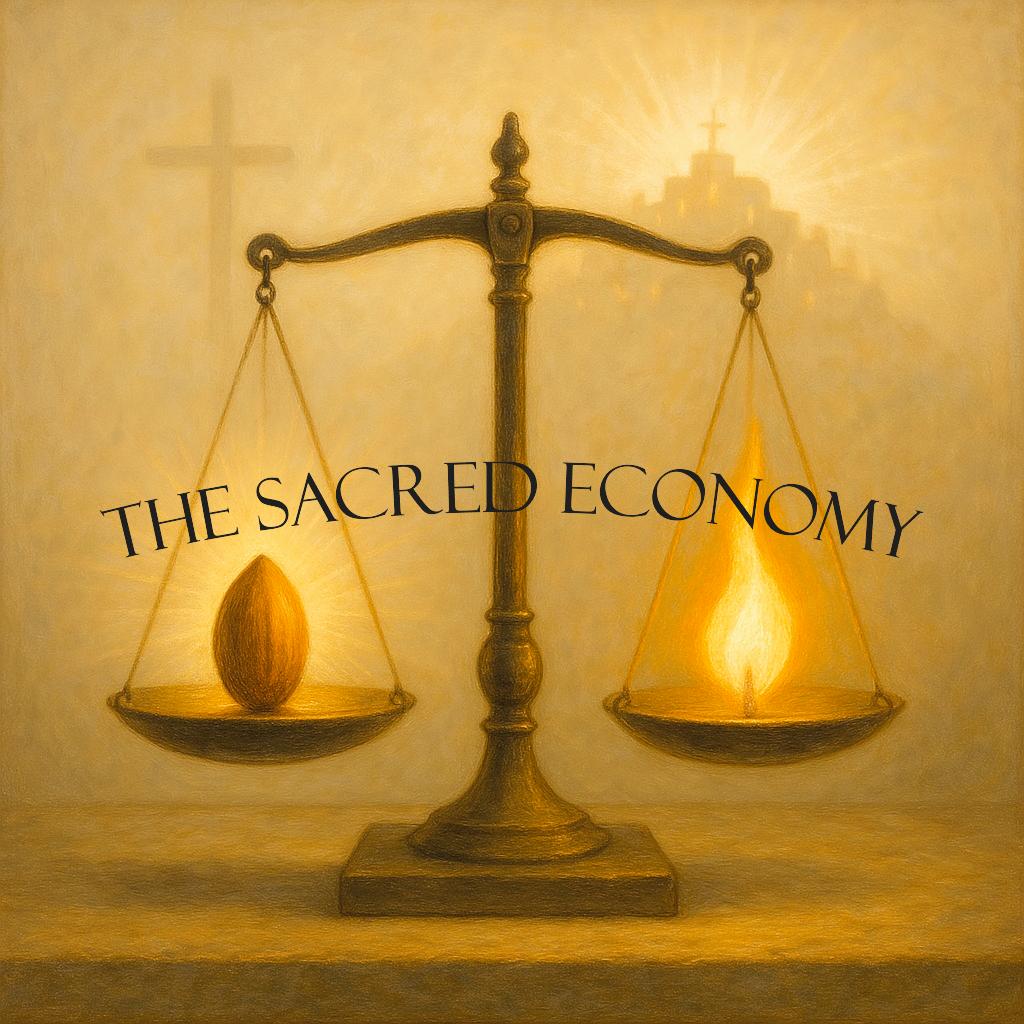
“To those who have, more will be given. To those who do not, even what they have will be taken away.”
— Matthew 25:29
The Divine Trust: Stewardship, Responsibility, and the Nature of Gifts
In both Orthodox and more recent traditions, Matthew 25 is not a call one can simply ignore. A banner of excellence to faithful stewardship. The parable of the talents is not merely about money, it is about gifts, grace, opportunity, and responsibility.
- There is in one sense an emphasis on the moral obligation to use one’s gifts for the common good. The talents in this understanding symbolize divine grace and burying them is a failure to participate in God’s redemptive work. I could argue that this is the supreme calling of all image-bearing creatures, but I will spare you the sermon.
- There is another sense that highlights individual responsibility and the royal priesthood of all believers. In this understanding, each person is called to serve God with what they’ve been given. They are not to act out of fear or obligation. Instead, they act out of faith that the work we do is worthy. This work will be rewarded if we are faithful.
All traditions agree: God entrusts, and we are accountable.
- Finally, there is the logical and objective lens. Through this understanding, we see Matthew 25 encoded in the very fabric of reality. The accumulation of means follows a familiar pattern. It’s said that if you put ten people in a room, each with a dollar, one will eventually walk out with all ten. I’ve never found the verified source, but the truth in it sticks.
Throughout the natural order, there is this hierarchy within each kingdom. Jordan Peterson’s allegory of the lobster illustrates it well. It is seen in the cycles of nature. Its echoes are heard in the law of entropy. More holistically, it appears in the predictable rhythms of growth. It also manifests in decay. We often call this the survival of the fittest. Nature rewards what is used, what adapts, what multiplies. What lies dormant, what remains unused, what remains hidden is reclaimed by the earth.
Yet in our human striving, we often try to beat the best out of the fittest.
To redistribute strength, to lift the fallen, to equalize the field. This can be a weakness, but also mercy.
It is the divine paradox: justice and compassion in constant tension.
Here, we must take care to strike the balance between:
“Let each one carry his own burden”
— Galatians 6:5
and
“Bear one another’s burdens, and so fulfill the law of Christ.”
— Galatians 6:2
This is the razor’s edge of wisdom.
You must know when to let someone rise by their own strength. You must also know when to lend your shoulder so they may stand.
“The tree bends with the wind and does not break. The river yields to the stone yet wears it down. Strength lies not in resistance alone, but in knowing when to yield.”
So too, the Matthew 25 Principle is not a rigid law, but a living current. Even among the brutality of beasts there are elements of compassion.
How much more should this be seen within the thinking creature?
What will it take for us to invest what we have already been given?
To discern when it is possible to lift others without losing ourselves.
How can we today begin to walk the narrow path between justice and grace?
Conviction Over Coercion: A Higher Justice for the Least of These
The second half of Matthew 25 (verses 31–46) shifts from stewardship to what we call social justice:
“Whatever you did for one of the least of these brothers and sisters of mine, you did for me.”

Subscribe to continue reading
Subscribe to get access to the rest of this post and other subscriber-only content.
 Matty Thinks
Comments
One response to “To Bury or To Become: Reflecting on Matthew 25”